GCSE Calculator Paper Tips: What to Expect and How to Prepare
Essential tips for GCSE mathematics calculator papers. Understand question types, topics covered, and strategies for achieving your best score.
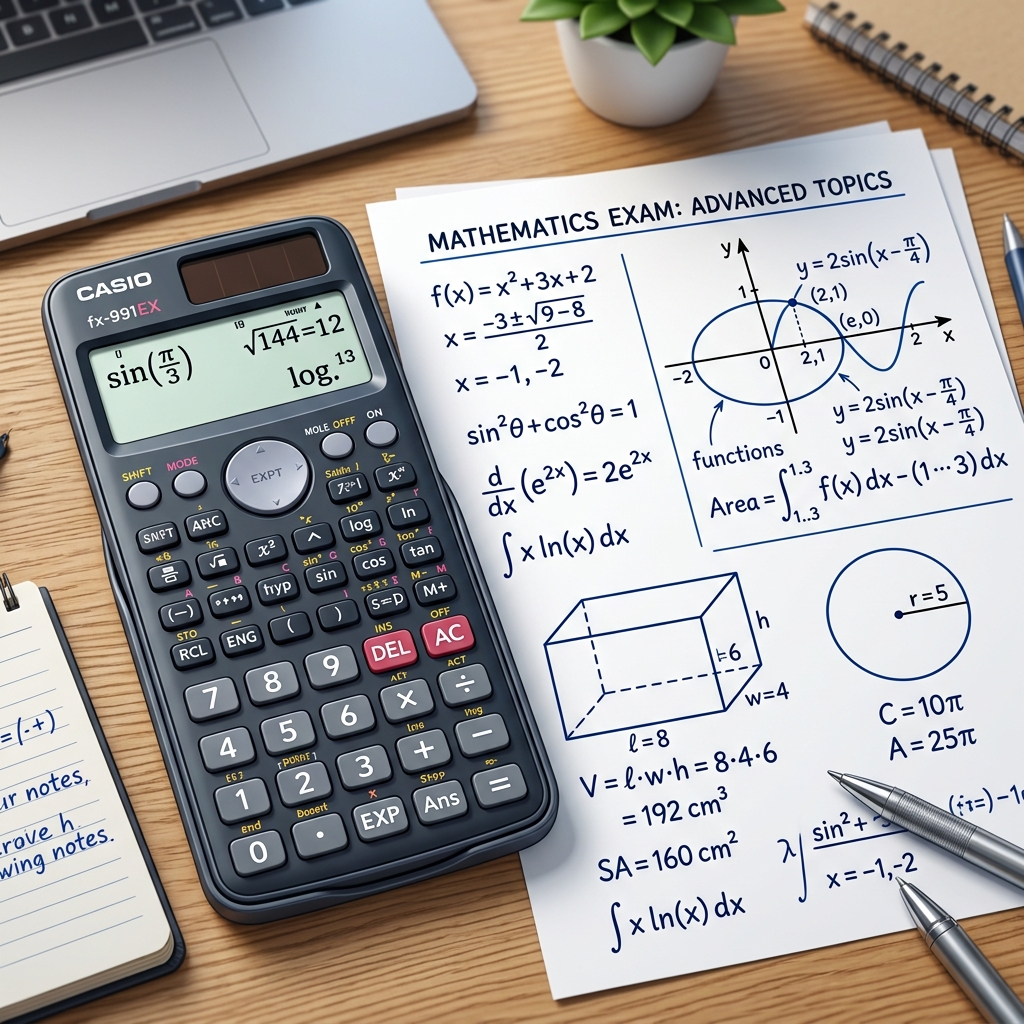
Understanding GCSE Calculator Papers
GCSE mathematics examinations typically include both calculator and non-calculator papers. The calculator paper allows you to use a scientific calculator, which means questions can involve more complex calculations.
What Topics Appear on GCSE Calculator Papers?
GCSE-style calculator papers commonly include questions on:
- Number: Standard form, surds (Higher), bounds
- Algebra: Solving equations, graphs, sequences
- Ratio & Proportion: Direct and inverse proportion
- Geometry: Area, volume, Pythagoras, trigonometry
- Probability & Statistics: Averages, charts, probability calculations
Key Strategies
Know Your Calculator
Make sure you know how to use your calculator’s key functions:
- Fraction button
- Square root and powers
- Trigonometric functions (sin, cos, tan)
- Memory functions
- Brackets
Show Your Working
Even on a calculator paper, you need to show your working. Method marks are available even if your final answer is wrong.
Check for Reasonableness
After using your calculator, ask yourself: “Does this answer make sense?” A triangle with an area of 5000 cm² when the sides are 10 cm should raise a red flag.
Practice with Calculator Paper
The best way to prepare is regular practice. Use the Calculator Paper Generator to create GCSE-style practice papers tailored to your needs.